Well to start off this unit was simple...It seemed like a piece of cake, but right now that point of view that I have just changed... This unit is really difficult, it requires a lot more thinking than I thought it would. The way the questions are worded and the solutions that seem to be the exact opposite of what you do... It's either you over think or under think how to answer the question...
Well the test is tomorrow and I am NOT looking forward to it. I don't feel that I'm ready for it. But there's nothing I can do about it... :P... Oh well I'll just say good luck to everyone... :P
Showing posts with label MilesM. Show all posts
Showing posts with label MilesM. Show all posts
Monday, May 28, 2007


Monday, May 7, 2007
... <-- Ellipse

Once again my scribe post comes late. (This is Ronald McDonald’s fault…) lol… But anyways… Let's start learning about ECLIPSES
We started off the class by figuring out if the two questions below are circles or ellipses…
x2 + y2 – 10x +4y + 20 = 0
x2 + y2 + 6x - 2y + 12 = 0
But before that let’s do a little recall from the past lessons from a couple of days ago…
h = x- coordinate for the circle’ center
k = y – coordinate for the circle’s center
r = radius of the circle
Equation of a Circle:
(x – h)2 + (y – k)2 = r2
Equation of a Horizontal Ellipse:

Equation of a Vertical Ellipse

“a” would always be the higher denominator, which leaves the other one which is then named
“b”.
“a2” defines an ellipse as horizontal or vertical.
If “a2” is below the “x - value” then it is a
horizontal ellipse, then if it’s below the “y - value” then it is a vertical ellipse.
Now Back to the Scribe post I go…
x2 + y2 – 10x +4y + 20 = 0
First we group the X- Values and Y-Values, then give them homes (parentheses).
(x2– 10x) + (y2 +4y) + 20 = 0
Then we prepare to complete the square so we subtract 20 from other side of the equation.
(x2– 10x) + (y2 +4y) = - 20
Now we can complete the square…
RECALL:
Completing Squares…
You take the Coefficient of “x”, divide it by 2 and then square it. The answer is then added to both sides of the equation
SO…
(x2– 10x + 25) + (y2 + 4y + 4) = - 20 + 25 + 4
Factoring out the given we get…
(x – 5) 2 + (y + 2) 2 = 9 -------- (x – h)2 + (y – k)2 = r2
From the simplified form of x2 + y2 – 10x +4y + 20 = 0 we can now derive the circle’s CENTER and RADIUS…
CENTER (h, k) = (5 , -2) RADIUS = 3
**************************************************
Similarly, we do the same steps for this equation…
x2 + y2 + 6x - 2y + 12 = 0
(x2 + 6x) + (y2 - 2y) + 12 = 0
(x2 + 6x) + (y2 - 2y) = - 12
(x2 + 6x + 9) + (y2 - 2y + 1) = - 12 + 9 + 1
(x + 3) 2 + (y - 1) 2 = -2 -------- (x – h)2 + (y – k)2 = r2
From the simplified form of x2 + y2 + 6x - 2y + 12 = 0 we can now derive the circle’s CENTER and RADIUS…
CENTER (h, k) = (-3 , 1)
RADIUS = -2 or 2i (Imaginary)
THE ANATOMY OF AN ELLIPSE
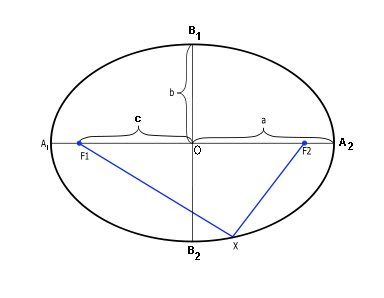
O: The center of the circle
A: Vertices or The End Points of the Major Axis
They are “a” units away from the center of the ellipse
2a = Length of the Major Axis
B: End Points of the Minor axis
They are “b” units away from the center of the ellipse
2b = Length of the Minor Axis
F: FOCUS (Plural: Foci)
They are “c” units away from the center of the ellipse
The Blue Line is called the Focal
Radii. The sum is equal to the Major Axis or
“2a”
READING THE STANDARD FORM OF AN ELLIPSE

For a Horizontal Ellipse...

For Vertical Ellipses...
SOLVING FOR THE EQUATION OF AN ELLIPSE
**Find the Coordinates of the Foci...
**Find the Coordinates of the Vertices...
**Find the Length of the Major and Minor Arcs...
x2 + 36y2 = 36
One side of the equation has to be be equal to 1. The only way to make one side equal one is to divide 36 by itself.
(x2 / 36)+ (36y2 / 36)= 36 / 36
Dividing both sides by 36 you get...
(x2 / 36) + y2 = 1
So far we are able to determine the center of the ellipse... which is (0 , 0) since there is no values for "h" and for "k".
Now you can use the formula for the ellipse to get the variables needed to get the values of a, b & c. But first we have to figure out if the ellipse is horizontal or vertical. How? By looking for the denominator with the highest value or "a2". Since "y" ' s denominator is 1 and "x" ' s denominator is 36, a2 must be equal to 36, meaning that the ellipse is horizontal.

You can now use the formula for a Horizontal Ellipse to get the values of "a", "b" and "c"
a = 6 , b = 1
Remember that the Major Axis is equal to 2a, and the Minor Axis is equal to 2b...
Major Axis is 12
Minor Axis is 2

This triangle comes from the Semi- Major Axis, Semi- Minor Axis and Focal Radius.
Now that the values of "a" and "b" have been found, we can use the Pythagorean Property to find the value of "c"
c2 = a2 - b2
C = Root of 35
Therefore the Coordinates of the Focal Points/ Foci are...
( 35^(1/2), 0 ) and ( - [35^(1/2)], 0 )
That's it for now guys and girls... (i'll prolly edit this post tomorrow...) to add some moret things to it...
So the next scribe will be.....
DANNY!!!
Is it the new cycle already?
Monday, April 16, 2007
Brilliant Online Bloggers

For me, this unit has been very interesting, but at the same time confusing and hard.
One thing that has been hammered in our heads for a million times:
There's a lot of equations that were given to us through out the past week... Here are some of them...

Wednesday, April 4, 2007
FlickR Assignment
THE BATTLE OF THERMOPYLAE...
Well since everyone has theirs posted on the blog I'll post mine
up to coz it seems like my tag isn't working when I search for it.

Friday, March 16, 2007
Sponge BOB
 | The early bird catches the worm... So I decided to do my BOB while I am still unable to sleep... So this unit will be a challenge for me, partly because I wasn't in class for 3 1/2 lessons. But I kinda understand |
| most of the things in it. There was Eddie and his very inspiring message to us from Georgia. The SINE dance is one of the main highlights of this unit. Well, there's Pi Day, where we ate at least 12 different kinds of pie. I have had enough pie for the whole year! Here are something's I learned: |

Wednesday, March 14, 2007
Shall We Dance ??
 | Sorry for the EXTREMELY late post guys… I had to go the McDonald's Amazing Race in St. Vital Mall… But my team lost… L Apologies for any mistakes made in the post since I had my first lesson on identities today. If there are any mistakes, please tell me right away. Also I haven’t blogged for the longest time… Probably for the last 9 or 10 months. So we started of with a review about identities: cos2θ – sin2θ = 1 – 2sinθ 1 – 2 sin2θ Q.E.D. |

Quite a few points to take note of when writing down our answers were also given. One of them was to put your intermediate steps/ show more work so we can still get part marks in tests.
Later in we discuss the how identities are odd or even. SIN and TAN functions are ODD and COS functions are even.
sin(-θ) = - sin (θ) cos(-θ) = cosθ tan(-θ) = - tan (θ)
Mr. K gave us some pointers on how to do identities like doing the more complicated identities first, rewriting both sine and cosine and simplifying complex fractions. Then here goes the best part of class……

What is it for?? Its for remembering this:
sin(α [+/-] β) = (sin α )( cos β ) [+/-] ( cos α )( sin β )
cos(α [+/-] β) = (cos α )( cos β ) [+/-] ( sin α )( sin β )
The SINE DANCE for kinesthetic learning, where our body learns how to do things by repetitively doing or seeing it. Just like how we can dial a phone number with our fingers and not our hands, or how we know where our friends’ houses are without knowing their exact address.
If I feel like it I’ll try making a video on YouTube for the sine dance… Wanna join me Richard?? LOL…

Then we did some exercise:
The lesson was pretty much just having to do the proper evaluation of a function/ identities : sin = sin cos +/- cos sin and cos = cos cos + sin sin… After figuring out where those are it will be easy for us to continue…
Lastly we went through how to find α and β if only sine or cosine is given:

After being finding the sin β and the cos α, we can now answer the questions:
Now that we have found sin β and cos α, we can now solve the four equations that we were given in today’s class.
Find:
sin( α + β) sin( α – β) cos( α – β) cos (α + β)
This would just be the part with the simple math so I don’t think I need to show you guys this. We would just use the given data of sin α and cos β, and what we have for sin β and cos α, and plug them in for each of the equivalent values of the four problems.
REMEMBER: While solving for anything make sure that you have the brackets, especially when there are negative numbers and you're multiplying them.To know what quadrants are answers are at we have to find the quadrants of the sine and cosine, compare them and voila… we have our answer
HAPPY PI DAY!!!
The next scribe would be….
g O t M e L k
Thanks for covering for me last Monday Sam…
Wednesday, February 21, 2007
BOB
Hmm... I have never done this BOB thing before... So I'll start of by saying....

Mathematics, the science of patterns, has been a challenge to all of us ever since we started school. From Addition to Subtraction, then Multipication and Division, we eventually end up in the midst of a very chaotic world filled with cotangents, quadratic formulas, circular functions and things like that. As the adventure goes on we face the horrors of the Circular Functions Quiz but we still stand strong and now the real challenge of this unit comes closer... "The Test"...
DABC.... I seem to always forget how to graph sin and cos functions... If only I had a way of figuring a way to remember it a lot easier... Hehehe... DABC really is a lot of help for all of us when we're graphing sine and cosine functions....
There's one thing I'm sure everyone will agree about......
One of the things that got me so confused was the exact values for cosecant, secant and cotangent. Apparently, we're suppose to get the functions reciprocal equivalent (iunno what to call it...):
cscθ = 1 / sin θ
secθ = 1 / cosθ
cotθ = cosθ / sinθ
Then look for the exact value of the radian from there....
Well that's it for this post folks... Hope you have yourself a great day.... And Good Luck on the Test...
REMEMBER! KNOWLEDGE IS POWER!
Can you be random-ER than this?
Subscribe to:
Posts (Atom)


