This is our final BOB for this course... Our last unit, Sequences, has concluded. We are now going to prepare for our last test.
I found this unit very cool because I learned a lot about sequences... We learned the formula for finding the "nth" term of the given arithmetic sequence to be...
tn = t1 + (n-1)d
And for the geometric sequence...
tn = t1 (r)^n-1
We also learned how to calculate the sum of a given arithmetic sequence. Instead of adding all the terms, we could simply use this formula...
Sn = (n/2) (2t1 + (n - 1)d)
For a geometric series...
Sn = t1 (1 - r^n)/(1 - r)
I hope everyone will do their very best... Remember, its our LAST chance to improve our term mark...
Showing posts with label jann. Show all posts
Showing posts with label jann. Show all posts
Monday, June 4, 2007


Wednesday, May 30, 2007
Sequence Sequel v.02
Hey guys! This is Jann, and I'll be your scribe for today! =D
We started of our lecture with some "quickies"...
1. Find the value(s) of "r" in 5r^4 = 80
Solution:
In order to solve this question, we just use algebraic methods...
 2. In the geometric sequence, if t1 = 3 and r = 2, find t3.
Solution:
If we can recall the rule for geometric sequences from last class... 3. If the first term of a geometric progression is 1/3 and the common ratio is -3, find the next 3 terms.
Solution:
In order to solve this, we can simply use the geometric sequence rule to find t2, t3, and t4...
 4. Determine the common ratio for the geometric sequence; 1/(x^1/2), 1, (x^1/2).
Solution:
In order to solve this problem, first we pick either the first, second, or third term. We can concentrate on that term to find the common ratio, "r". There is one catch, if we let n = 1, our common ratio will be 1 since "n-1" is the exponent of the ratio. If we use n = 1, then the exponent will be 0, meaning, r will equal 1 (anything to the power of 0 is 1)...
I'll pick the 2nd term... Then, Mr. K told us the story of the great Johann Carl Friedrich Gauss
So, I'll try to tell the story.. XD
One day, Gauss' teacher asked his students to "find the sum of the numbers from 1 to 100". During his time, there were no papers to write on, just slates. His classmates started to add up all the numbers, starting 1. (Man... this is gonna take forever...) Gauss didn't touch his slate and thought about it for approximately 1.5 to 2 mins. He wrote the number 5050 on his slate and handed it in to his teacher. (Even the teacher doesn't know the answer to this one...)
The big question was... "How in the world did he do that?!"
This is how he did it...
1 + 2 + 3 + 4 .... 97 + 98 + 99 + 100
100 + 99 + 98 + 97.... 4 + 3 + 2 + 1
101 101 101 101 .... 101 101 101 101
If we add 2 copies of the sequence, in which one is written in reverse order, we could see a pattern...
Then, Gauss simply put together these numbers... It means that the number 101 has been obtained 100 times in his method. He figured that this answer has been added twice. Therefore, he multiplied the answer by 1/2.
In other words...
Since 2t + nd = t + (t + nd) = t0 + tn,
For any arithmetic sequence, the series could be found by using the Arithmetic Summation...
x+ (x + d) + (x + 2d) + ... + (x + nd) = (n + 1)(a0 + an)/2
or

Where:
"Sn" is the sum of all the numbers up to the "nth" term
" n " is the rank of the nth term
" t1" is the first term in the sequence
" d " is the common difference
A series is the sum of numbers in a sequence to a particular term in a sequence.
For a geometric sequence...
Sn = t1 ( 1 - r^n)/(1 - r)
Where:
"t1" is the first term
"r" is the common ratio
"n" is the rank of the term
Finally, we talked about the "Sigma Notation". It's a short-hand way of writing a series.
 The "funky" looking "E" is a Greek letter for "sum". The number above the "E" means "to find the value of n, until we have obtained the nth term of the sequence. "n-1" means that this is the initial value of the sequence; meaning, you have to start evaluating at n-1. "2n - 1" is the "rule" of the given sequence.
That's what we did for this class. (Finally, I have edited my scribe post! Yay!)
Oh well, good night everyone! I'm tired...
Next scribe will be... once again... "BERTMAN" XD.
We started of our lecture with some "quickies"...
1. Find the value(s) of "r" in 5r^4 = 80
Solution:
In order to solve this question, we just use algebraic methods...
 2. In the geometric sequence, if t1 = 3 and r = 2, find t3.
Solution:
If we can recall the rule for geometric sequences from last class...
 3. If the first term of a geometric progression is 1/3 and the common ratio is -3, find the next 3 terms.
Solution:
In order to solve this, we can simply use the geometric sequence rule to find t2, t3, and t4...
 4. Determine the common ratio for the geometric sequence; 1/(x^1/2), 1, (x^1/2).
Solution:
In order to solve this problem, first we pick either the first, second, or third term. We can concentrate on that term to find the common ratio, "r". There is one catch, if we let n = 1, our common ratio will be 1 since "n-1" is the exponent of the ratio. If we use n = 1, then the exponent will be 0, meaning, r will equal 1 (anything to the power of 0 is 1)...
I'll pick the 2nd term...
 Then, Mr. K told us the story of the great Johann Carl Friedrich Gauss
So, I'll try to tell the story.. XD
One day, Gauss' teacher asked his students to "find the sum of the numbers from 1 to 100". During his time, there were no papers to write on, just slates. His classmates started to add up all the numbers, starting 1. (Man... this is gonna take forever...) Gauss didn't touch his slate and thought about it for approximately 1.5 to 2 mins. He wrote the number 5050 on his slate and handed it in to his teacher. (Even the teacher doesn't know the answer to this one...)
The big question was... "How in the world did he do that?!"
This is how he did it...
1 + 2 + 3 + 4 .... 97 + 98 + 99 + 100
100 + 99 + 98 + 97.... 4 + 3 + 2 + 1
101 101 101 101 .... 101 101 101 101
If we add 2 copies of the sequence, in which one is written in reverse order, we could see a pattern...
Then, Gauss simply put together these numbers...
 It means that the number 101 has been obtained 100 times in his method. He figured that this answer has been added twice. Therefore, he multiplied the answer by 1/2.
In other words...
| t | + | (t + d) | + | (t + 2d) | + ... + | (t + nd) |
| (t + (n-1)d) | + | (t + (n-2)d) | + | (t + (n-3)d) | + ... + | t |
| (2x + (n-1)d) | + | (2x + (n-1)d) | + | (2x + (n-1)d) | + ... + | (2x + (n-1)d) |
Since 2t + nd = t + (t + nd) = t0 + tn,
For any arithmetic sequence, the series could be found by using the Arithmetic Summation...
x+ (x + d) + (x + 2d) + ... + (x + nd) = (n + 1)(a0 + an)/2
or

Where:
"Sn" is the sum of all the numbers up to the "nth" term
" n " is the rank of the nth term
" t1" is the first term in the sequence
" d " is the common difference
A series is the sum of numbers in a sequence to a particular term in a sequence.
For a geometric sequence...
Sn = t1 ( 1 - r^n)/(1 - r)
Where:
"t1" is the first term
"r" is the common ratio
"n" is the rank of the term
Finally, we talked about the "Sigma Notation". It's a short-hand way of writing a series.
 The "funky" looking "E" is a Greek letter for "sum". The number above the "E" means "to find the value of n, until we have obtained the nth term of the sequence. "n-1" means that this is the initial value of the sequence; meaning, you have to start evaluating at n-1. "2n - 1" is the "rule" of the given sequence.
That's what we did for this class. (Finally, I have edited my scribe post! Yay!)
Oh well, good night everyone! I'm tired...
Next scribe will be... once again... "BERTMAN" XD.
Monday, May 28, 2007
BOB
Hello everyone! Once again, we have finished another unit of our course. Probability has been a very interesting unit because it practices your thinking skills. For me, figuring out chances on how a certain thing will occur is pretty cool. I found the "Tree Diagram" very interesting because it shows you the sample spaces of a certain event.
I hope everyone will do well on this test. This is our 2nd last chance to improve our test marks... -_-
Good luck y'all!! XD
I hope everyone will do well on this test. This is our 2nd last chance to improve our test marks... -_-
Good luck y'all!! XD
Sunday, May 13, 2007
BOB
Hey y'all! We have finished our unit on Conics. This has been a really short unit. We've learned about the standard formula of a parabola, circle, ellipse and, a hyperbola. We did a few paper-folding to help us find some patterns and relationships between the points and distances. This unit has been very easy to understand.
I hope everyone will do good on the test tomorrow! =D
I hope everyone will do good on the test tomorrow! =D
Monday, April 30, 2007
BOB the Snail
We have finished the unit on Counting. In this unit, I found it very interesting because it exercises the logical thinking of the students. In this unit, we learned how to use the "Pick" Formula and the "Choose" formula. These two formulas are NOT similar. These 2 terms may be synonyms, but they work differently. The "Pick" formula is used when the order of the objects matter without repetition. The "Choose" formula is used when the order of the objects doesn't matter. We should remember that these two formulas are DIFFERENT.
I hope everyone will study hard for the dreadful test. =D
I hope everyone will study hard for the dreadful test. =D
Scribe Post: Preparing for the Counting Test
Good day y'all! This is Jann and I'll be your scribe for today.
Reminder: YOU CAN, I repeat, YOU CAN EDIT your DEV projects if you already published your projects.
Morning Class:
This morning, we had our pre-test. Here are the answers.
1. 7 teams compete in a men's hockey league. If each team plays each other twice, how many games are necessary to complete the league schedule?
Solution:
2. The sum of the seventh row of Pascal's triangle is the same solution to;
Solution:
Since the 7th row in Pascal's Triangle is 64, which is the same as 2^6, we need to find which of these choices have the same answer...
 Since (b) is 2^6, the answer is (b).
3. Suppose the last four digits of a telephone number must include at least one repeated digit. How many such numbers are there?
Solution:

4. A multiple choice exam has 20 questions, each with four possible answers, and 10 additional questions, each with five possible answers. How many different answer sheets are possible?
Solution:
 5. In a 52 card deck, how many 5 card poker hands are possible that have exactly two pair? one pair?
Solution: That's all we did this morning...
Afternoon Class:
This afternoon, we did our usual group workshops...
Here are the questions:
1.

2.

3.
 * the first digit is 9 in (a) because we can't use 0 as a first number. That would make it a 2 digit number instead. (eg. 024)
* the first number is 8 in (b) because we already used a number for the last one to make the digit odd. The next choice is 8 again because this time, we included 0.
* The first solution is for the digit to end in 5, the 2nd solution is for the digit to end in 0. (Both are divisible by 5) For the 2nd solution, the first number is 9 because 0 is in the last digit already, so we don't have to restrict it for the first number.
4. * In (a), the answer is 7! because we don't care about the order of the books.
* In (b), the answer is 5!3! because if we put the 3 French books in a bag, it is considered as "1". Therefore we have 5 objects to arrange. (5!) After that we remove the 3 books from the bag and multiply 3! to the answer. The 3 books can be arranged in 3 different ways.
* In (c), the question is similar to the "word" problems. Since there are 4 similar objects, they are non-distinguishable.
5.

6.

7.

8.

9.

Reminder: There is no, I repeat, NO test tomorrow because of a multimedia presentation at the gym.
Well... That's all we did for the day. I hope everything was clear. Next scribe is... Grey-M! =D
Reminder: YOU CAN, I repeat, YOU CAN EDIT your DEV projects if you already published your projects.
Morning Class:
This morning, we had our pre-test. Here are the answers.
1. 7 teams compete in a men's hockey league. If each team plays each other twice, how many games are necessary to complete the league schedule?
Solution:

2. The sum of the seventh row of Pascal's triangle is the same solution to;
Solution:
Since the 7th row in Pascal's Triangle is 64, which is the same as 2^6, we need to find which of these choices have the same answer...
 Since (b) is 2^6, the answer is (b).
3. Suppose the last four digits of a telephone number must include at least one repeated digit. How many such numbers are there?
Solution:

4. A multiple choice exam has 20 questions, each with four possible answers, and 10 additional questions, each with five possible answers. How many different answer sheets are possible?
Solution:
 5. In a 52 card deck, how many 5 card poker hands are possible that have exactly two pair? one pair?
Solution:
 That's all we did this morning...
Afternoon Class:
This afternoon, we did our usual group workshops...
Here are the questions:
1.

2.

3.
 * the first digit is 9 in (a) because we can't use 0 as a first number. That would make it a 2 digit number instead. (eg. 024)
* the first number is 8 in (b) because we already used a number for the last one to make the digit odd. The next choice is 8 again because this time, we included 0.
* The first solution is for the digit to end in 5, the 2nd solution is for the digit to end in 0. (Both are divisible by 5) For the 2nd solution, the first number is 9 because 0 is in the last digit already, so we don't have to restrict it for the first number.
4.
 * In (a), the answer is 7! because we don't care about the order of the books.
* In (b), the answer is 5!3! because if we put the 3 French books in a bag, it is considered as "1". Therefore we have 5 objects to arrange. (5!) After that we remove the 3 books from the bag and multiply 3! to the answer. The 3 books can be arranged in 3 different ways.
* In (c), the question is similar to the "word" problems. Since there are 4 similar objects, they are non-distinguishable.
5.

6.

7.

8.

9.

Reminder: There is no, I repeat, NO test tomorrow because of a multimedia presentation at the gym.
Well... That's all we did for the day. I hope everything was clear. Next scribe is... Grey-M! =D
Thursday, April 5, 2007
Flickr Assignment
Hi ya'll! This is the URL for my Flickr Assignment on Trigonometry...
Click on the image to view the hot spots. =D
Click on the image to view the hot spots. =D
Friday, March 16, 2007
BOB
Hi everyone! Our unit on Trigonometric Identities has come to an end. I really enjoyed this unit. We learned the different identities of trigonometry, especially the wicked awesome cool Sine Dance! XD
We also learned that we don't have to memorize all those Trig ID's. Mr. K said that we just need to memorize a few, such as sin^2(θ) + cos^2(θ) = 1. We can derive the other identities from them.
Mr. K said, "The only way to get good as this, is to do more of this..." For me, its a very good thing if you keep on practicing these problems. For some reason, the ID's get stuck in your head if you keep practicing and practicing.
I hope everyone will do well on the next test. NO PROCRASTINATING! XD
We also learned that we don't have to memorize all those Trig ID's. Mr. K said that we just need to memorize a few, such as sin^2(θ) + cos^2(θ) = 1. We can derive the other identities from them.
Mr. K said, "The only way to get good as this, is to do more of this..." For me, its a very good thing if you keep on practicing these problems. For some reason, the ID's get stuck in your head if you keep practicing and practicing.
I hope everyone will do well on the next test. NO PROCRASTINATING! XD
Wednesday, March 7, 2007
BOB
Hi everyone! Our unit on Transformations is almost done. We are now getting ready for the 2nd test. This unit has been really interesting. We learned a lot of things on how to shift, stretch and/or compress a function graph. We learned about the Standard Form, f(x) = Af(Bx-C) + D. Its a bit similar to the standard form of Trig. Functions, but the values work in a different way.
A affects the graph by stretching (A > 0), or compressing (0< A < 1) its y coordinate.
B affects the graph by stretching (0< B <1), or compressing (0 < B) its x coordinate.
C affects the graph by shifting it to the left (0>C), or shifting it to the right (C>0). Watch for the sign of C because the standard form changes the sign of C.
D affects the graph by shifting it to the left (0>C), or shifting it to the right (C>0).
We also looked at the Reciprocal Functions. We learned that the root of the original function, f(x), is the vertical asymptote of the reciprocal function. The invariant points, -1 & 1, are both in the function and the reciprocal function since the reciprocal of 1 & -1 are themselves. We learned how to graph the reciprocal function by doing the "Smallering & Biggering" Game.
We looked at The Absolute Functions. The first step is to graph the original function. Then any part of the graph below the x-axis must be reflected along the positive side of the y-axis.
Finally, we looked at Trigonometric Modeling. We're not quite familiar with the material yet, that's why we are continuing with our discussion.
I hope everyone will do well on the next test. ^_^
A affects the graph by stretching (A > 0), or compressing (0< A < 1) its y coordinate.
B affects the graph by stretching (0< B <1), or compressing (0 < B) its x coordinate.
C affects the graph by shifting it to the left (0>C), or shifting it to the right (C>0). Watch for the sign of C because the standard form changes the sign of C.
D affects the graph by shifting it to the left (0>C), or shifting it to the right (C>0).
We also looked at the Reciprocal Functions. We learned that the root of the original function, f(x), is the vertical asymptote of the reciprocal function. The invariant points, -1 & 1, are both in the function and the reciprocal function since the reciprocal of 1 & -1 are themselves. We learned how to graph the reciprocal function by doing the "Smallering & Biggering" Game.
We looked at The Absolute Functions. The first step is to graph the original function. Then any part of the graph below the x-axis must be reflected along the positive side of the y-axis.
Finally, we looked at Trigonometric Modeling. We're not quite familiar with the material yet, that's why we are continuing with our discussion.
I hope everyone will do well on the next test. ^_^
Thursday, March 1, 2007
Absolutely!
Hi ya'll! This is Jann and I'll be your scribe for today.
Morning Class:
We had a quiz on transformations. We went over the answers like we always do. Then, we started a lesson on Graphing Absolute Functions.
There are 2 easy steps used to graph an absolute function.
Step 1: Sketch the graph of y = f(x).
Step 2: Reflect all the parts of the graph below the x-axis over the x-axis.
Here's an example: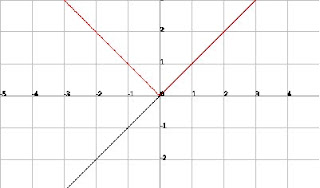.bmp)
The Black graph is the graph of y = x. The absolute value changes the negative output of the graph into a positive output. Where x<0, the negative outputs were changed to positive outputs.
Then, we looked at the graph of y=abs(2-x).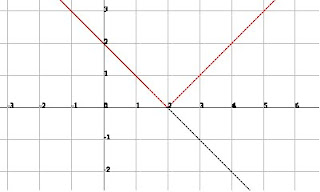.bmp) According to our steps, we need to graph y = 2-x first. Then, we reflected the negative inputs of this graph towards the x-axis to make them positive; as shown by the red graph.
According to our steps, we need to graph y = 2-x first. Then, we reflected the negative inputs of this graph towards the x-axis to make them positive; as shown by the red graph.
That's all we did for the morning class.
Afternoon Class:
We looked at this graph:
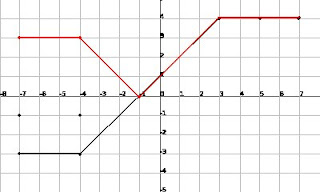 This graph has a function:
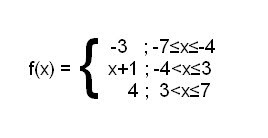 The Red graph shows the absolute value of the function. The black graph shows the original function.
Mr. K showed us how to graph this in our calculator. After researching and testing, (yay!) We were able to find the syntax to graph this in our calculator. Here's a small step-by-step procedure on how to graph this piecework:
Step 1: Press [Y=]
Step 2: Enter this syntax in "Y1"...
Y1 = (-3)(-7≤x)(x≤-4)+(x+1)(-4≤x)(x≤3)+(4)(3≤x)(x≤7)
Step 3: If there are "funky-looking" lines in your graph, press [Mode] then change "Connected" to "Dot". Press [Mode] again, then change it back to "Connected".
Mr. K also showed us how to graph the absolute value of this function. Here are the steps:
Step 1: Go back to the syntax entered in [Y1].
Step 2: Press [2nd] [Del] for "Insert".
Step 3: Press [MATH], then press [->] to go to "NUM".
Step 4: Press [1] for the "abs(" command.
Step 5: Place the cursor to the end of the syntax, then press [ ) ].
Your [Y1] should look something like this...
abs((-3)(-7≤x)(x≤-4)+(x+1)(-4≤x)(x≤3)+(4)(3≤x)(x≤7))
Then ♫TA-DA♫! Wicked awesome cool eh?
Then we looked at the graph of f(x) = abs(x^2-4)...
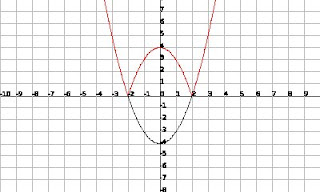 The part of the graph that is located below the x-axis was reflected along the x-axis.
Note: Watch out for the concavity (opens up or down) when graphing. We need to make sure the concavities of the graphs are properly drawn.
Then, we did a little bit of review regarding the Reciprocal Functions.
1. Given y = f(x), sketch the graph of y = 1/f(x).
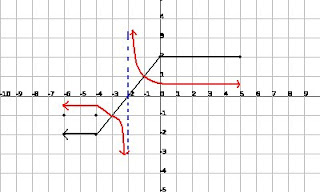 According to our rules, first find the "Invariant Points". Then, we find the asymptote(s), where the original graph has a root. Then we play the "Smallering & Biggering Game".
Finally, we looked at the reciprocal graph of f(x) = 2sinx...
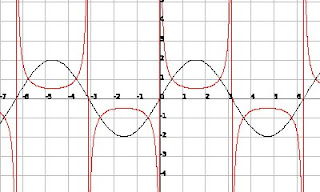 If you got the graph of 1/(sin(x)), the invariant points are connected to the minimums and maximums of the graph. In this case, the graph of 2sin(x) stretches the graph 2 units. The asymptotes are located at k"pi".
That's all we did today! This post should have been posted earlier, but I had a few disturbances.
Oh yeah! JENG is the next scribe.☺
Morning Class:
We had a quiz on transformations. We went over the answers like we always do. Then, we started a lesson on Graphing Absolute Functions.
There are 2 easy steps used to graph an absolute function.
Step 1: Sketch the graph of y = f(x).
Step 2: Reflect all the parts of the graph below the x-axis over the x-axis.
Here's an example:
.bmp)
The Black graph is the graph of y = x. The absolute value changes the negative output of the graph into a positive output. Where x<0, the negative outputs were changed to positive outputs.
Then, we looked at the graph of y=abs(2-x).
.bmp) According to our steps, we need to graph y = 2-x first. Then, we reflected the negative inputs of this graph towards the x-axis to make them positive; as shown by the red graph.
According to our steps, we need to graph y = 2-x first. Then, we reflected the negative inputs of this graph towards the x-axis to make them positive; as shown by the red graph.That's all we did for the morning class.
Afternoon Class:
We looked at this graph:
 This graph has a function:
 The Red graph shows the absolute value of the function. The black graph shows the original function.
Mr. K showed us how to graph this in our calculator. After researching and testing, (yay!) We were able to find the syntax to graph this in our calculator. Here's a small step-by-step procedure on how to graph this piecework:
Step 1: Press [Y=]
Step 2: Enter this syntax in "Y1"...
Y1 = (-3)(-7≤x)(x≤-4)+(x+1)(-4≤x)(x≤3)+(4)(3≤x)(x≤7)
Step 3: If there are "funky-looking" lines in your graph, press [Mode] then change "Connected" to "Dot". Press [Mode] again, then change it back to "Connected".
Mr. K also showed us how to graph the absolute value of this function. Here are the steps:
Step 1: Go back to the syntax entered in [Y1].
Step 2: Press [2nd] [Del] for "Insert".
Step 3: Press [MATH], then press [->] to go to "NUM".
Step 4: Press [1] for the "abs(" command.
Step 5: Place the cursor to the end of the syntax, then press [ ) ].
Your [Y1] should look something like this...
abs((-3)(-7≤x)(x≤-4)+(x+1)(-4≤x)(x≤3)+(4)(3≤x)(x≤7))
Then ♫TA-DA♫! Wicked awesome cool eh?
Then we looked at the graph of f(x) = abs(x^2-4)...
 The part of the graph that is located below the x-axis was reflected along the x-axis.
Note: Watch out for the concavity (opens up or down) when graphing. We need to make sure the concavities of the graphs are properly drawn.
Then, we did a little bit of review regarding the Reciprocal Functions.
1. Given y = f(x), sketch the graph of y = 1/f(x).
 According to our rules, first find the "Invariant Points". Then, we find the asymptote(s), where the original graph has a root. Then we play the "Smallering & Biggering Game".
Finally, we looked at the reciprocal graph of f(x) = 2sinx...
 If you got the graph of 1/(sin(x)), the invariant points are connected to the minimums and maximums of the graph. In this case, the graph of 2sin(x) stretches the graph 2 units. The asymptotes are located at k"pi".
That's all we did today! This post should have been posted earlier, but I had a few disturbances.
Oh yeah! JENG is the next scribe.☺
Monday, February 19, 2007
BOB
Hi guys! We're done the first unit and we're getting ready for the test. I really found this unit straight forward. For me, Mr. K is doing a wicked awesome cool job when it comes to teaching. I learned a lot from this unit. I really like the mnemonic "DABC" because its a good way to know how to graph trig functions. The Unit Circle took a while to be memorized. Mr. K taught us a lot of ways to memorize the unit circle. For example, the scales of the x and y axis have the roots of 1,2,3 all over 2. This unit has been really interesting. I hope everyone will do well on the test. XD
Subscribe to:
Posts (Atom)


