Hello everyone! Sorry again for the late scribe. I just really needed some more time to study before the exam today. Hopefully everyone did a super good job on it! =D
Well, on Friday, if I remember correctly was review for the exam on Logarithms and Exponents, Probability and Trigonometric Identities. The reviews are done the exact same way we do our pretests! All the questions and answers are on the slides. Click here.
The exam is pretty much over so it's kind of a relief for all of us. There's still classes tomorrow!! Scribe for tomorrow shall be.....
I think the it's a new cycle, so I chooose.. Vincent!
- Sandy <3
Showing posts with label Scribe. Show all posts
Showing posts with label Scribe. Show all posts
Saturday, June 9, 2007
Thursday, June 7, 2007
PRECAL40S: LAST SCRIBE ... for me at least.
HEY GUYS! sorry my scribe was a day late. I had work yesterday and came home very late so anyways I will be the scribe for yesterday and today ... here goes
JUNE 6, 2007: MORNING CLASS
We had an exam rehearsal for Circular Funtions


The answers are pretty straight forward ...
JUNE 6, 2007: AFTERNOON CLASS
We had another exam rehearsal for Combinatories

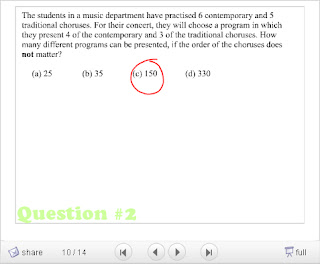


and again the answers are pretty straight forward ...
JUNE 7, 2007: MORNING CLASS
Yet, Again we had another exam rehearsal for Logarithm. We had a substitute for Mr. K. She didn't really gave us numbers to be in groups so instead we chose our own groups. Everyone worked on it but in the end we found out that we didn't have to hand it in. The answers are not up yet but I'm pretty sure Mr. K will put it up sometime later tonight. Well that's all for now and the scribe for tomorrow's class is .... SANDY!
JUNE 6, 2007: MORNING CLASS
We had an exam rehearsal for Circular Funtions


The answers are pretty straight forward ...
JUNE 6, 2007: AFTERNOON CLASS
We had another exam rehearsal for Combinatories


and again the answers are pretty straight forward ...
JUNE 7, 2007: MORNING CLASS
Yet, Again we had another exam rehearsal for Logarithm. We had a substitute for Mr. K. She didn't really gave us numbers to be in groups so instead we chose our own groups. Everyone worked on it but in the end we found out that we didn't have to hand it in. The answers are not up yet but I'm pretty sure Mr. K will put it up sometime later tonight. Well that's all for now and the scribe for tomorrow's class is .... SANDY!
Monday, June 4, 2007
SCRIBE
Another scribe post in the words of Jojo Rocks.
Was surprised finding out I was scribe of all days. Yet today was pretty interesting. In the morning we had our pre-test, a very interesting pre-test mind you and it seemed everyone had a fine idea how this unit worked. Good thing the equations were on the board. I have enough trouble remembering every other equation... Anyways we were put into groups and the room lit up with conversations. My group was interesting, 2 great minds working while 1 great mind in progress (me) layed back with a question mark on his head nodding to everything they agreed too. Just kidding.. Time ran out quickly so we had to wait to see how some answers turned out the way they did.
So yeah, the afternoon class came right away. My mind was sorta somewhere else since I have a short film wit ha script to create by Thursday I think. But yeah we went through the 5Th question on the pre-test since it had some issues for some people. although a lot of people had different rounded numbers we all were pretty close. Funny how a funny worded problem had so many solutions to it. The podcast recording stopped working again. Twice. Blamed it on Richard, the usual stuff. After that was all over and done with we did some homework based questions as review which are on the slides.
There was an interesting talk about the Koch snowflake and how there are 10 different dimensions. Mr. K explained how a square won't see a sphere and how we'd see ourselves as worms if we saw in the 4th dimension. Very hard to comprehend but sounds very easy to say. Don't you love that? Scribe tomorrow is... SAM!
Just kidding Sam, Sorry Jeng your it!
Was surprised finding out I was scribe of all days. Yet today was pretty interesting. In the morning we had our pre-test, a very interesting pre-test mind you and it seemed everyone had a fine idea how this unit worked. Good thing the equations were on the board. I have enough trouble remembering every other equation... Anyways we were put into groups and the room lit up with conversations. My group was interesting, 2 great minds working while 1 great mind in progress (me) layed back with a question mark on his head nodding to everything they agreed too. Just kidding.. Time ran out quickly so we had to wait to see how some answers turned out the way they did.
So yeah, the afternoon class came right away. My mind was sorta somewhere else since I have a short film wit ha script to create by Thursday I think. But yeah we went through the 5Th question on the pre-test since it had some issues for some people. although a lot of people had different rounded numbers we all were pretty close. Funny how a funny worded problem had so many solutions to it. The podcast recording stopped working again. Twice. Blamed it on Richard, the usual stuff. After that was all over and done with we did some homework based questions as review which are on the slides.
There was an interesting talk about the Koch snowflake and how there are 10 different dimensions. Mr. K explained how a square won't see a sphere and how we'd see ourselves as worms if we saw in the 4th dimension. Very hard to comprehend but sounds very easy to say. Don't you love that? Scribe tomorrow is... SAM!
Just kidding Sam, Sorry Jeng your it!
Sunday, June 3, 2007
Hello!it's albert M. and I'm the scribe for the last friday. Since we're done in all of our units, we are just preparing for the last test which is the "Sequence" and also for our upcoming provincial exam this coming June 11. We just go over with some problems like these: the first one was just a warm up so it was easy. You are just going to use the formula to find tn and that's it.
 First thing that we did was, we divided 8748 by 36 and got a quotient of 243 then we took the 5th root of it and got 3 as the common ratio. Then, we used the formula, plug-in the numbers and solve for the missing term.
 (n-1)
(n-1)
using this formula tn = t1r we apply what we had learned in logarithms to find the value of n.
 First one:
k = 1 tells you that k will starts at 1 and will end at 4.
Therefore plug in 1-4 for the k in to the 3k.
Chris showed the long method or the sum formula to get it done.
Second one:
k = 0 tells you that k will starts at 0 and will end at 3.
Therefore plug in 0-3 for the k to the 2^k.
Chris used the long method again to show it is the same.
 Mr. K asked us to come up with two more different sigma notation for the same value and here's some of our answers. You can write the sigma notation of the same value in infinity ways.
 We can use what we have learned to Mr. Green in his video clips that you can find in youtube, as we get the common ratio for the numbers in geometric sequence or you can divide the first two numbers, if you get r<1 then it converges and when r>1 therefore the answer diverges which you can see above.
 We got the perimeter of the first triangle = 42
  This is so pretty straight forward so i won't explain it.
We are working on the last question which is the last clip but the bell rang already so we're just going to continue it on Monday which will be later discussed by Jojo who rocks!
 the first one was just a warm up so it was easy. You are just going to use the formula to find tn and that's it.
 First thing that we did was, we divided 8748 by 36 and got a quotient of 243 then we took the 5th root of it and got 3 as the common ratio. Then, we used the formula, plug-in the numbers and solve for the missing term.
 (n-1)
(n-1)using this formula tn = t1r we apply what we had learned in logarithms to find the value of n.
 First one:
k = 1 tells you that k will starts at 1 and will end at 4.
Therefore plug in 1-4 for the k in to the 3k.
Chris showed the long method or the sum formula to get it done.
Second one:
k = 0 tells you that k will starts at 0 and will end at 3.
Therefore plug in 0-3 for the k to the 2^k.
Chris used the long method again to show it is the same.
 Mr. K asked us to come up with two more different sigma notation for the same value and here's some of our answers. You can write the sigma notation of the same value in infinity ways.
 We can use what we have learned to Mr. Green in his video clips that you can find in youtube, as we get the common ratio for the numbers in geometric sequence or you can divide the first two numbers, if you get r<1 then it converges and when r>1 therefore the answer diverges which you can see above.
 We got the perimeter of the first triangle = 42
 the perimeter of the second triangle = 21
the perimeter of the third triangle = 10.5
You can notice the pattern already didn't you?
try to get its common ratio by dividing the second number to the first number or the third number to the second one.
Lastly, use the formula for infinity then you'll get 84 as an answer.
 This is so pretty straight forward so i won't explain it.
We are working on the last question which is the last clip but the bell rang already so we're just going to continue it on Monday which will be later discussed by Jojo who rocks!
Thursday, May 31, 2007
Scribe
Hey it's Bertman and it looks like I'm todays scribe.
We started the morning gonig to the gym for the M.A.D.D multimedia presentation. Driving under the influence is a serious offense that dangers yourself and everyone around. Driving high goes the same way, so don't do it!
Anyways we started the afternoon class by watching a youtube video created a by Mr. Greene. The video shows him teach and show everything and anything about our unit, sequences in a matter of 3-4 minutes. Amazing isn't it?
Heres the link : http://youtube.com/watch?v=WjLSz-nNLBc

Following thw questions from the slide, the sum of the intergers 1-5000 can be found by using Gauss' formula. Where "n" = 5000, "t1" = 1 and "d" = 1. Simplifying we get a huge number, 12 502 500.
To find the sum of the numbers from 1-5000 that are multiples of 7, you start by dividing 5000 by 7 to get a value. Which is 714 different numbers. Using Gauss' formula again, "n" is now 714, "t1" = 7 and "d" = 7. Simplifying we get an answer of 1 786 785.
To find the sum of the intergers between 1-5000 excluding the numbers that aren't multiples of 7 can be found by just subtracting the 2 answers previously solved. Mr. K also told us we would be normally given this question and not the first 2.
Now we get to the super-bouncy ball questions!

There are 2 distances the ball creates. Distances bouncing up, and dropping down.
The distance of the ball when it's going down decreases by 1/4.
The distance of the ball when it's going up decreases by 1/4
We started the morning gonig to the gym for the M.A.D.D multimedia presentation. Driving under the influence is a serious offense that dangers yourself and everyone around. Driving high goes the same way, so don't do it!
Anyways we started the afternoon class by watching a youtube video created a by Mr. Greene. The video shows him teach and show everything and anything about our unit, sequences in a matter of 3-4 minutes. Amazing isn't it?
Heres the link : http://youtube.com/watch?v=WjLSz-nNLBc
Following thw questions from the slide, the sum of the intergers 1-5000 can be found by using Gauss' formula. Where "n" = 5000, "t1" = 1 and "d" = 1. Simplifying we get a huge number, 12 502 500.
To find the sum of the numbers from 1-5000 that are multiples of 7, you start by dividing 5000 by 7 to get a value. Which is 714 different numbers. Using Gauss' formula again, "n" is now 714, "t1" = 7 and "d" = 7. Simplifying we get an answer of 1 786 785.
To find the sum of the intergers between 1-5000 excluding the numbers that aren't multiples of 7 can be found by just subtracting the 2 answers previously solved. Mr. K also told us we would be normally given this question and not the first 2.
Now we get to the super-bouncy ball questions!
There are 2 distances the ball creates. Distances bouncing up, and dropping down.
The distance of the ball when it's going down decreases by 1/4.
The distance of the ball when it's going up decreases by 1/4
By using the geometric formula, when it's going down, "t1" = 200, "r" = 3/4 and "n" = 4 since we want to find the distances after it hits the ground for the 4th time. When it's going up, "t1" = 150, "r" = 3/4 amd "n" = 3. By adding both numbers we get a total of 893.75.

There is another way to solve this type of question. When using 150 as "t1" the total distance from that first initial bounce to the second is 300. Therefore "t1" can be 300. The other values are the same and you get 693.75 as an answer. Don't forget the add the distances you left out depending on where you started. By adding 200 we get the answer again of 893.75.
Everything else are on the slides, from the sum of inifinity formula and the relationship from the value "r" to the words convergence and divergence. I don't know if we're supposed to pick scribes now that all the units are over but I choose Albert M.
Wednesday, May 30, 2007
Sequence Sequel v.02
Hey guys! This is Jann, and I'll be your scribe for today! =D
We started of our lecture with some "quickies"...
1. Find the value(s) of "r" in 5r^4 = 80
Solution:
In order to solve this question, we just use algebraic methods...
 2. In the geometric sequence, if t1 = 3 and r = 2, find t3.
Solution:
If we can recall the rule for geometric sequences from last class... 3. If the first term of a geometric progression is 1/3 and the common ratio is -3, find the next 3 terms.
Solution:
In order to solve this, we can simply use the geometric sequence rule to find t2, t3, and t4...
 4. Determine the common ratio for the geometric sequence; 1/(x^1/2), 1, (x^1/2).
Solution:
In order to solve this problem, first we pick either the first, second, or third term. We can concentrate on that term to find the common ratio, "r". There is one catch, if we let n = 1, our common ratio will be 1 since "n-1" is the exponent of the ratio. If we use n = 1, then the exponent will be 0, meaning, r will equal 1 (anything to the power of 0 is 1)...
I'll pick the 2nd term... Then, Mr. K told us the story of the great Johann Carl Friedrich Gauss
So, I'll try to tell the story.. XD
One day, Gauss' teacher asked his students to "find the sum of the numbers from 1 to 100". During his time, there were no papers to write on, just slates. His classmates started to add up all the numbers, starting 1. (Man... this is gonna take forever...) Gauss didn't touch his slate and thought about it for approximately 1.5 to 2 mins. He wrote the number 5050 on his slate and handed it in to his teacher. (Even the teacher doesn't know the answer to this one...)
The big question was... "How in the world did he do that?!"
This is how he did it...
1 + 2 + 3 + 4 .... 97 + 98 + 99 + 100
100 + 99 + 98 + 97.... 4 + 3 + 2 + 1
101 101 101 101 .... 101 101 101 101
If we add 2 copies of the sequence, in which one is written in reverse order, we could see a pattern...
Then, Gauss simply put together these numbers... It means that the number 101 has been obtained 100 times in his method. He figured that this answer has been added twice. Therefore, he multiplied the answer by 1/2.
In other words...
Since 2t + nd = t + (t + nd) = t0 + tn,
For any arithmetic sequence, the series could be found by using the Arithmetic Summation...
x+ (x + d) + (x + 2d) + ... + (x + nd) = (n + 1)(a0 + an)/2
or

Where:
"Sn" is the sum of all the numbers up to the "nth" term
" n " is the rank of the nth term
" t1" is the first term in the sequence
" d " is the common difference
A series is the sum of numbers in a sequence to a particular term in a sequence.
For a geometric sequence...
Sn = t1 ( 1 - r^n)/(1 - r)
Where:
"t1" is the first term
"r" is the common ratio
"n" is the rank of the term
Finally, we talked about the "Sigma Notation". It's a short-hand way of writing a series.
 The "funky" looking "E" is a Greek letter for "sum". The number above the "E" means "to find the value of n, until we have obtained the nth term of the sequence. "n-1" means that this is the initial value of the sequence; meaning, you have to start evaluating at n-1. "2n - 1" is the "rule" of the given sequence.
That's what we did for this class. (Finally, I have edited my scribe post! Yay!)
Oh well, good night everyone! I'm tired...
Next scribe will be... once again... "BERTMAN" XD.
We started of our lecture with some "quickies"...
1. Find the value(s) of "r" in 5r^4 = 80
Solution:
In order to solve this question, we just use algebraic methods...
 2. In the geometric sequence, if t1 = 3 and r = 2, find t3.
Solution:
If we can recall the rule for geometric sequences from last class...
 3. If the first term of a geometric progression is 1/3 and the common ratio is -3, find the next 3 terms.
Solution:
In order to solve this, we can simply use the geometric sequence rule to find t2, t3, and t4...
 4. Determine the common ratio for the geometric sequence; 1/(x^1/2), 1, (x^1/2).
Solution:
In order to solve this problem, first we pick either the first, second, or third term. We can concentrate on that term to find the common ratio, "r". There is one catch, if we let n = 1, our common ratio will be 1 since "n-1" is the exponent of the ratio. If we use n = 1, then the exponent will be 0, meaning, r will equal 1 (anything to the power of 0 is 1)...
I'll pick the 2nd term...
 Then, Mr. K told us the story of the great Johann Carl Friedrich Gauss
So, I'll try to tell the story.. XD
One day, Gauss' teacher asked his students to "find the sum of the numbers from 1 to 100". During his time, there were no papers to write on, just slates. His classmates started to add up all the numbers, starting 1. (Man... this is gonna take forever...) Gauss didn't touch his slate and thought about it for approximately 1.5 to 2 mins. He wrote the number 5050 on his slate and handed it in to his teacher. (Even the teacher doesn't know the answer to this one...)
The big question was... "How in the world did he do that?!"
This is how he did it...
1 + 2 + 3 + 4 .... 97 + 98 + 99 + 100
100 + 99 + 98 + 97.... 4 + 3 + 2 + 1
101 101 101 101 .... 101 101 101 101
If we add 2 copies of the sequence, in which one is written in reverse order, we could see a pattern...
Then, Gauss simply put together these numbers...
 It means that the number 101 has been obtained 100 times in his method. He figured that this answer has been added twice. Therefore, he multiplied the answer by 1/2.
In other words...
| t | + | (t + d) | + | (t + 2d) | + ... + | (t + nd) |
| (t + (n-1)d) | + | (t + (n-2)d) | + | (t + (n-3)d) | + ... + | t |
| (2x + (n-1)d) | + | (2x + (n-1)d) | + | (2x + (n-1)d) | + ... + | (2x + (n-1)d) |
Since 2t + nd = t + (t + nd) = t0 + tn,
For any arithmetic sequence, the series could be found by using the Arithmetic Summation...
x+ (x + d) + (x + 2d) + ... + (x + nd) = (n + 1)(a0 + an)/2
or

Where:
"Sn" is the sum of all the numbers up to the "nth" term
" n " is the rank of the nth term
" t1" is the first term in the sequence
" d " is the common difference
A series is the sum of numbers in a sequence to a particular term in a sequence.
For a geometric sequence...
Sn = t1 ( 1 - r^n)/(1 - r)
Where:
"t1" is the first term
"r" is the common ratio
"n" is the rank of the term
Finally, we talked about the "Sigma Notation". It's a short-hand way of writing a series.
 The "funky" looking "E" is a Greek letter for "sum". The number above the "E" means "to find the value of n, until we have obtained the nth term of the sequence. "n-1" means that this is the initial value of the sequence; meaning, you have to start evaluating at n-1. "2n - 1" is the "rule" of the given sequence.
That's what we did for this class. (Finally, I have edited my scribe post! Yay!)
Oh well, good night everyone! I'm tired...
Next scribe will be... once again... "BERTMAN" XD.
Tuesday, May 29, 2007
Scribe - Introduction to Sequences
Hello to everyone once again. Today I am scribing on both the morning class and the afternoon class. In the morning class we had a test on probability so there isn’t much I can talk about there. That’s it for the morning class. For the afternoon class, we started a new unit called sequences. Before we jumped into the work, Mr. K talked to us about fractal and showed us a video on it from www.youtube.com. If you would like to take a look at it, you can look to Mr. K’s post. After that we started off by taking a look at some problems:
Find the next 3 numbers in each sequence of numbers.
4, 7, 10, 13, , , … Answer: 4, 7, 10, 13, 16, 19, 22…
3, 6, 12, 24, , , … Answer: 3, 6, 12, 24, 48, 96, 192…
32, 16, 8, 4, , , … Answer: 32, 16, 8, 4, 2, 1, 0.5…
1, 1, 2, 3, 5, 8, 13, , , … Answer: 1, 1, 2, 3, 5, 8, 13, 21, 34, 55…
From each of these sequences, we can find out if they are geometric, arithmetic, or neither. Also if it is geometric, then we can find the common ratio and if it is arithmetic, then we can find the common difference. Here are some definitions to help you out:
Sequence: An ordered list of numbers that follow a certain pattern (or rule).
Arithmetic Sequence :(i) Recursive Definition: An ordered list of numbers generated by continuously adding a value (the common difference) to a given first term.
(ii) Implicit Definition: An ordered list of numbers where each number in the list is generated by a linear equation.
Common Difference (d):(i) The number that is repeatedly added to successive terms in an arithmetic sequence. (ii) From the implicit definition, d is the slope of the linear equation.
Geometic Sequence: (i) Recursive Definition: An ordered list of numbers generated by continuously multiplying a value (the common ratio) with a given first term.
(ii) Implicit Definition: An ordered list of numbers where each number in the list is generated by an exponential equation.
Common Ratio (r): (i) The number that is repeatedly multiplied to successive terms in a geometic sequence. (ii) From the implicit definition, r is the base of the exponential function.
Well that’s it for today and that just about covers everything that we went over today in class. Hopefully this helps you guys out a little bit more.
The next scribe is…Bertman!
Homework is exercise 45!
Find the next 3 numbers in each sequence of numbers.
4, 7, 10, 13, , , … Answer: 4, 7, 10, 13, 16, 19, 22…
3, 6, 12, 24, , , … Answer: 3, 6, 12, 24, 48, 96, 192…
32, 16, 8, 4, , , … Answer: 32, 16, 8, 4, 2, 1, 0.5…
1, 1, 2, 3, 5, 8, 13, , , … Answer: 1, 1, 2, 3, 5, 8, 13, 21, 34, 55…
From each of these sequences, we can find out if they are geometric, arithmetic, or neither. Also if it is geometric, then we can find the common ratio and if it is arithmetic, then we can find the common difference. Here are some definitions to help you out:
Sequence: An ordered list of numbers that follow a certain pattern (or rule).
Arithmetic Sequence :(i) Recursive Definition: An ordered list of numbers generated by continuously adding a value (the common difference) to a given first term.
(ii) Implicit Definition: An ordered list of numbers where each number in the list is generated by a linear equation.
Common Difference (d):(i) The number that is repeatedly added to successive terms in an arithmetic sequence. (ii) From the implicit definition, d is the slope of the linear equation.
Geometic Sequence: (i) Recursive Definition: An ordered list of numbers generated by continuously multiplying a value (the common ratio) with a given first term.
(ii) Implicit Definition: An ordered list of numbers where each number in the list is generated by an exponential equation.
Common Ratio (r): (i) The number that is repeatedly multiplied to successive terms in a geometic sequence. (ii) From the implicit definition, r is the base of the exponential function.
Well that’s it for today and that just about covers everything that we went over today in class. Hopefully this helps you guys out a little bit more.
The next scribe is…Bertman!
Homework is exercise 45!
Monday, May 28, 2007
Probability Pre-Test
Hello, i am the class scribe for this evening. We started today's class with a pre-test, because tomorrow is our long awaited test on probability. Basically the Pre-test had lasted almost the full class, because many of the students had questions about the questions on the pre-test. So to not get carried away here are the questions and the solutions to the pre-test questions.
question #1: Twelve people including you are members of the choir. The choir director is going to choose three members to attend a workshop. The probability you and two other members will be chosen is:
a. 1/4 b. 3/10 c. 1/12 d. 1/10
The answer is 1/4, because you are going so it is 1 * 11c2, because there are 11 members left and the director needs to pick two of them. It is all over 12c3, because it is over all the possibilities. So once that is calculated it is 1/4.
question #2: Rex is playing a guessing game. The probability he will guess each question correct is 0.3. What is the probability he will guess exactly 5 out of 10 questions correctly?
a. 0.15 b. 0.10 c. 0.29 d. 0.80
The answer is 0.10, because he must get 5 out of 10 questions correct so it is RRRRRWWWWW.
So it is 10!/5!*5!, because there are 5w's and 5r's. Then the 10!/5!*5! is multiplied by (0.3)^5*(0.7)^5 which is the binomial theorem. So once it is all worked out you achieve the answer of 0.10.
question#3: You choose 4 digits from the numbers (0-9), with no repeated digits. To win a prize only two numbers need to match the four selected by the computer.The probability, correct to the nearest one hundredth that you will win a prize.
The answer is 54.76%, because you must take the amount of numbers you are able to match with the computer to win a prize in this case 4c2, 4c3, or 4c4 numbers and divide them over all the possibilities which is 10c4, and add them all up. Once added and reduced it should give you a fraction:23/42, which is 54.76%.
question#4: The serial number of a $10 bill contains 8 digits. If your $10 bill contains the digit 7 at least once, you win a prize. What is the probability that your $10 bill will win?
The answer is you must find the probability of when there are no 7's and then you take the complement. So no 7's is basically 9 out of the possible 10 numbers to the exponent (^) of 8, because there is 8 digits. It gives you an answer of 0.4305, so to get the probability that there is a 7 you must take the complement, so 1 - 0.4305 = 56.95%. which is the answer.
question#5: Jeff takes a lunch to school on two days, and on the other three days he buys it. If he takes lunch he is late for his fourth period class 15% of the time, but if he buys it, he is late 35% of the time.
A) what is the probability that Jeff arrives on time?
The answer is that we take percentages of the two times he arrives and add them together to form the answer. So P(o) = P(to) + P(bo) = (0.4)(0.85) + (0.6)(0.65) = 73% which is the answer.
B) If Jeff was late, what is the probability that he took his lunch to school?
The answer is that you must take the probability he was late and took his lunch to school divided by the time he was late and brought his lunch plus the time he was late and bought his lunch. (0.4)(0.15)/(0.4)(0.15) + (0.6)(0.35) = 2/9 or 22.22% which is the answer.
So he is all of what we had done in class to day, when viewing this scribe post make sure to check the slides if you are confused, because it may help you find the way I had shown the answer. Make sure to study because tommorow is our Probability Test.
Tommorow's scribe is Robert P.
question #1: Twelve people including you are members of the choir. The choir director is going to choose three members to attend a workshop. The probability you and two other members will be chosen is:
a. 1/4 b. 3/10 c. 1/12 d. 1/10
The answer is 1/4, because you are going so it is 1 * 11c2, because there are 11 members left and the director needs to pick two of them. It is all over 12c3, because it is over all the possibilities. So once that is calculated it is 1/4.
question #2: Rex is playing a guessing game. The probability he will guess each question correct is 0.3. What is the probability he will guess exactly 5 out of 10 questions correctly?
a. 0.15 b. 0.10 c. 0.29 d. 0.80
The answer is 0.10, because he must get 5 out of 10 questions correct so it is RRRRRWWWWW.
So it is 10!/5!*5!, because there are 5w's and 5r's. Then the 10!/5!*5! is multiplied by (0.3)^5*(0.7)^5 which is the binomial theorem. So once it is all worked out you achieve the answer of 0.10.
question#3: You choose 4 digits from the numbers (0-9), with no repeated digits. To win a prize only two numbers need to match the four selected by the computer.The probability, correct to the nearest one hundredth that you will win a prize.
The answer is 54.76%, because you must take the amount of numbers you are able to match with the computer to win a prize in this case 4c2, 4c3, or 4c4 numbers and divide them over all the possibilities which is 10c4, and add them all up. Once added and reduced it should give you a fraction:23/42, which is 54.76%.
question#4: The serial number of a $10 bill contains 8 digits. If your $10 bill contains the digit 7 at least once, you win a prize. What is the probability that your $10 bill will win?
The answer is you must find the probability of when there are no 7's and then you take the complement. So no 7's is basically 9 out of the possible 10 numbers to the exponent (^) of 8, because there is 8 digits. It gives you an answer of 0.4305, so to get the probability that there is a 7 you must take the complement, so 1 - 0.4305 = 56.95%. which is the answer.
question#5: Jeff takes a lunch to school on two days, and on the other three days he buys it. If he takes lunch he is late for his fourth period class 15% of the time, but if he buys it, he is late 35% of the time.
A) what is the probability that Jeff arrives on time?
The answer is that we take percentages of the two times he arrives and add them together to form the answer. So P(o) = P(to) + P(bo) = (0.4)(0.85) + (0.6)(0.65) = 73% which is the answer.
B) If Jeff was late, what is the probability that he took his lunch to school?
The answer is that you must take the probability he was late and took his lunch to school divided by the time he was late and brought his lunch plus the time he was late and bought his lunch. (0.4)(0.15)/(0.4)(0.15) + (0.6)(0.35) = 2/9 or 22.22% which is the answer.
So he is all of what we had done in class to day, when viewing this scribe post make sure to check the slides if you are confused, because it may help you find the way I had shown the answer. Make sure to study because tommorow is our Probability Test.
Tommorow's scribe is Robert P.
Sunday, May 27, 2007
Probability
Friday is grueling days ever because of 2 unexpected quizzes from Mr.K
First we started-off with this. The very first thing to do is to make a tree diagram and fill out the probability for each cases .The probability that Tony will move to Winnipeg is 2/9, and the probability he will marry Angelina if he moves to Winnipeg is 9/20, all you need to do is to multiply to the probability that Tony will move to Winnipeg and marry Angelina.
 To get this, all you need to do is to multiply the probability that he is moving to Winnipeg which is 2/9 and the probability that he is not marrying Angelina 11/20.
To get this multiply the probability that he is staying which is 7/9 and the probability that he is not marrying Angelina which is 19/20.
 This is the probability of drawing four aces in a standard deck of fifty-two cards.
This is the probability of drawing diamond cards.
This is the probability of drawing an ace and a diamond.
All you need to do is to add the probability of drawing four aces and diamond cards, then subtract the probability of drawing an ace and a diamond. To answer this question, you need to make a Venn Diagram. Then from that diagram you will see that ten out of twenty-five students doesn't like either Dr.Pepper or Diet Dr.Pepper.
 This is the probability of choosing two green dresses out of six.
This is the probability of choosing four dresses out of nine.
This is the probability of choosing six dresses out of fifteen.
All you need to do is just by dividing the favourable cases over the possible outcomes.
 First thing is to make a tree diagram and fill out the probability for each cases. Next is to get the probability of an SUV that has air conditioning and divide it by the probability of having a passenger car that has air conditioning plus the probability of an SUV that has air conditioning.
 To get this, just add the probability of drawing a defective blade first and then a good blade and the probability of drawing a good blade first and then a defective blade.
 For the 1st question, you can't use the number 0 as the first digit, so you nine choices left.
The 2nd digit, you can't pick the same number that you use before so you have nine choices left. The 3rd digit , you can't pick the same number that you use for the 1st and 2nd digit, so you have 8 choices left. The 4th digit, you can't pick the same number that you use from the previous three, so you have 7 choices left.
For the 2nd question, just divide the possibility of having an odd number by the total number of possible digits.
For the 3rd question, break the question into 2 steps,one is that ending in zero and the other is ending in 5, then add both . Then divide the answer by the total number of the possible digits.
 To get this, get the probability of getting exactly four hits out of 6 throws. Then, raise the probability of hitting to the fourth power and then the probability of missing to the second power.
That's it folks.By the way we have a pre-test tomorrow,sorry for the late scribe .The next scribe is DINO.
First we started-off with this. The very first thing to do is to make a tree diagram and fill out the probability for each cases .The probability that Tony will move to Winnipeg is 2/9, and the probability he will marry Angelina if he moves to Winnipeg is 9/20, all you need to do is to multiply to the probability that Tony will move to Winnipeg and marry Angelina.

 To get this, all you need to do is to multiply the probability that he is moving to Winnipeg which is 2/9 and the probability that he is not marrying Angelina 11/20.
To get this multiply the probability that he is staying which is 7/9 and the probability that he is not marrying Angelina which is 19/20.

 This is the probability of drawing four aces in a standard deck of fifty-two cards.
This is the probability of drawing diamond cards.
This is the probability of drawing an ace and a diamond.
All you need to do is to add the probability of drawing four aces and diamond cards, then subtract the probability of drawing an ace and a diamond.
 To answer this question, you need to make a Venn Diagram. Then from that diagram you will see that ten out of twenty-five students doesn't like either Dr.Pepper or Diet Dr.Pepper.
 This is the probability of choosing two green dresses out of six.
This is the probability of choosing four dresses out of nine.
This is the probability of choosing six dresses out of fifteen.
All you need to do is just by dividing the favourable cases over the possible outcomes.
 First thing is to make a tree diagram and fill out the probability for each cases. Next is to get the probability of an SUV that has air conditioning and divide it by the probability of having a passenger car that has air conditioning plus the probability of an SUV that has air conditioning.
 To get this, just add the probability of drawing a defective blade first and then a good blade and the probability of drawing a good blade first and then a defective blade.
 For the 1st question, you can't use the number 0 as the first digit, so you nine choices left.
The 2nd digit, you can't pick the same number that you use before so you have nine choices left. The 3rd digit , you can't pick the same number that you use for the 1st and 2nd digit, so you have 8 choices left. The 4th digit, you can't pick the same number that you use from the previous three, so you have 7 choices left.
For the 2nd question, just divide the possibility of having an odd number by the total number of possible digits.
For the 3rd question, break the question into 2 steps,one is that ending in zero and the other is ending in 5, then add both . Then divide the answer by the total number of the possible digits.
 To get this, get the probability of getting exactly four hits out of 6 throws. Then, raise the probability of hitting to the fourth power and then the probability of missing to the second power.
That's it folks.By the way we have a pre-test tomorrow,sorry for the late scribe .The next scribe is DINO.
Tuesday, May 22, 2007
Exactly why are doctors so cagey?!
Hey it's MrSiwWy here to present to you the scribe post for today! I'm the scribe for today's rather intriguing but yet solemn class. I say solemn as I think that the main question our class was focused around pertained to very serious matter. But anyways, onto the scribe post for
Tuesday, May 22, 2007.
Our class began with Mr. K outright stating to the class that we're on the verge of the end of probability, and the beginning of our final unit: sequences. He then told us that he won't be present the two following days, but that we only have two things left to learn in probability, one of which incorporates one of our earlier units: counting and combinatorics. He presented us with an example of such a question. This question was regarding the arrangement of students, like we have been presented with in the past.
If students are to be seated in 7 desks, what is the probability that Mark and Robert are sitting together?
Basically, we take amount of favorable outcomes, which would be the amount of ways Robert and Mark can be seated together, then divide that by the total amount of seating possibilities.
We quickly moved onto the class for today, and very soon, we transitioned into the question that Mr. K left us off with on Thursday; "Why do doctors have do so many tests? Why are they so cagey?" Once Mr. K put up the question we were to dissect, he set us up in small groups of four. This smoothly yet appropriately forwarded the momentum of our class into the actual lesson. This question can be seen on the following slide:
But as for people who do not have cancer, if the test shows positive, this means that the test failed, and this probability is in fact 2%, or 0.02, and the remaining probability (to test negative for those who do not have cancer) is 98%, or 0.98.
And as I stated at the end of the slide, a tree diagram can really help. So here is a tree diagram that was used to calculate the probabilities of each of the questions on the following slide.
The blue underlined portions indicate that we're dealing with people who have cancer.
The green underlined portions indicate that we're dealing with people who do not have cancer.
The small circular flower symbols indicate total amounts of people that have cancer.
The small stars indicate total amounts of people that have been tested positive for cancer.
The last two are particularly important because the main question that we were originally asked was what the probability of a patient that has cancer is also tested positive for cancer. In order to arrive at this, we must dignify how many total people have cancer, and divide that by the amount of people that were tested positive. We've already learned that in order to find the probability of an event, we take the amount of favorable outcomes and divide that by the total amount of outcomes. So in this case, we take the amount of subjects who have cancer, and divide that by the total amount of times that the test would show a positive result. That is why Mr. K signified each of the above portions. This was taken care of in part 4 of the above questions, but before that, I'd like to outline how to achieve each of the answers in the entire slide.
In order to determine each of the answers shown on this slide, we used the tree diagram above in conjunction with the sample group of 1,000,000 people.
Conditional probability is when we have some inside information on the events at hand, basically when we know some of the information before we even start to calculate.
When we are dealing with conditional probability we write P(P1P2), where P1 is the probability that we're looking for, the vertical line says "given that we already know", and P2 is the event that we already know.
Tuesday, May 22, 2007.
Our class began with Mr. K outright stating to the class that we're on the verge of the end of probability, and the beginning of our final unit: sequences. He then told us that he won't be present the two following days, but that we only have two things left to learn in probability, one of which incorporates one of our earlier units: counting and combinatorics. He presented us with an example of such a question. This question was regarding the arrangement of students, like we have been presented with in the past.
If students are to be seated in 7 desks, what is the probability that Mark and Robert are sitting together?
Basically, we take amount of favorable outcomes, which would be the amount of ways Robert and Mark can be seated together, then divide that by the total amount of seating possibilities.
We quickly moved onto the class for today, and very soon, we transitioned into the question that Mr. K left us off with on Thursday; "Why do doctors have do so many tests? Why are they so cagey?" Once Mr. K put up the question we were to dissect, he set us up in small groups of four. This smoothly yet appropriately forwarded the momentum of our class into the actual lesson. This question can be seen on the following slide:

But as for people who do not have cancer, if the test shows positive, this means that the test failed, and this probability is in fact 2%, or 0.02, and the remaining probability (to test negative for those who do not have cancer) is 98%, or 0.98.
And as I stated at the end of the slide, a tree diagram can really help. So here is a tree diagram that was used to calculate the probabilities of each of the questions on the following slide.

Mr. K later asked us to construct this tree diagram to help us understand the question's calculations, but really, to create one beforehand is more of a help.

The blue underlined portions indicate that we're dealing with people who have cancer.
The green underlined portions indicate that we're dealing with people who do not have cancer.
The small circular flower symbols indicate total amounts of people that have cancer.
The small stars indicate total amounts of people that have been tested positive for cancer.
The last two are particularly important because the main question that we were originally asked was what the probability of a patient that has cancer is also tested positive for cancer. In order to arrive at this, we must dignify how many total people have cancer, and divide that by the amount of people that were tested positive. We've already learned that in order to find the probability of an event, we take the amount of favorable outcomes and divide that by the total amount of outcomes. So in this case, we take the amount of subjects who have cancer, and divide that by the total amount of times that the test would show a positive result. That is why Mr. K signified each of the above portions. This was taken care of in part 4 of the above questions, but before that, I'd like to outline how to achieve each of the answers in the entire slide.
In order to determine each of the answers shown on this slide, we used the tree diagram above in conjunction with the sample group of 1,000,000 people.
- This part was simple. Since we know that there are 1,000,000 people, and 0.5% of these people have cancer, that means that 5000 people have cancer, and the rest don't. The rest can be found by subtracting how many that have cancer from the total of people, this gives us 995000.
- In this part we use the tree diagram to determine what percent of people that have cancer will test positive. To do this we multiplied the amount of people that have cancer, then multiplied that by the probability of testing positive, which is 0.98. This gave us 4900, the answer presented in the slide. For b, since we know 4900 tested positive, the rest of the people who have cancer must have tested negative, and that number is 100.
- Here we repeated the same process used in part 2, exact that we used different values since we're looking at only the people who do not have cancer. We know that there are 995000 people that do not have cancer, and as I outlined earlier, since the test would fail if it said positive, we would have to find 2% of 995000. This, as shown, is 19900, and to find how many tested negative, we just subtract this from the total. 995000-19900 gives us an answer of 975100.
- The final part was compounding what we determined in the previous steps, and in essence, determining the answer to our original question. First we take how many people altogether tested positive, we get this simply by adding those that have cancer that tested positive together with those that don't have cancer but tested positive. For b, we know that of the people that tested positive, 4900 of them actually had cancer. So to find the original question at hand, this was the work shown. I already described how this was found, here is the work:


Conditional probability is when we have some inside information on the events at hand, basically when we know some of the information before we even start to calculate.
When we are dealing with conditional probability we write P(P1P2), where P1 is the probability that we're looking for, the vertical line says "given that we already know", and P2 is the event that we already know.
Once we were finished with that question, we moved onto a very similar question, in which he just changed "cancer" to "industrial condition," 98 % to 99 % and 0.5% to 1%. Here is the question along with the work, of which I will of course explain.

Here we see both a tree diagram and the work to the solution for the question.
- I represents those with industrial disease.
- H represents those without industrial disease.
- P represents those that tested positive for the disease.
- N represents those that tested negative for the disease.
So in this class, we fully determined the answer to the question that Mr. K had left us with on Thursday afternoon.
Doctors aren't necessarily cagey, but run the tests more than once to make sure. If we look at the results that we achieved by both questions, we arrive at the fact that if someone really has the disease and tests positive, there's not a good chance that it's for sure. Thus, doctors run tests more than once not for fun or anything of the sort, but in both cases it's more likely or equally likely to be tested positive and not have the disease, so it's good to be sure before breaking such news to a person.
And that concluded our class for today, with the lesson of conditional probability that was presented to us today, as Mr. K said, we don't have a lot left in this unit. This was my scribe post, and I hope it was clear enough for anyone to understand. I still need to fix some content up, really don't like how my Computer is so resilient, especially seeing as I can't get to any pod casts. =/ But as soon as my computer begins to cooperate with me I'll get everything fixed up and tidy. Please just contact me if there are any concerns, questions, complaints, errors, etc. Have a good night everybody!
oh yes, thank you John for reminding me. The scribe for tomorrow will be: Jann!
Friday, May 18, 2007
LONG Weekend = LONG Scribe
This class was the second one of the unit of PROBABILITY. That is, as Grey-M stated in the last scribe post, the easy unit of PROBABILITY, but anyway...
...The class started with the student elections. 3 of the 4 candidates for the executive council were in our class so it was a fairly bid deal. (To see the results, check the post prior to this one by Sandy.)
After that, we reflected upon the extraordinary video display by Richard in the previous day's candidates' speeches. We liked it so much in fact, that we searched YouTube for it. We didn't find it, so instead we watched a video that was completely irrelevant to math, or anyone in our class for that matter =D.
Then, we got down to some "ACTUAL MATH!"
The first slide shown was a little too easy I believe, but Mr. K. didn't find it as such (haha!)
 Then, Mr. K presented us with on that was a little higher on the difficulty scale. We were to "TEST THE QUESTION FOR INDEPENDENCE".
We'll take a quick trip back and review exactly what an independent variable is:
 Thank You Grey-M! =)
...The class started with the student elections. 3 of the 4 candidates for the executive council were in our class so it was a fairly bid deal. (To see the results, check the post prior to this one by Sandy.)
After that, we reflected upon the extraordinary video display by Richard in the previous day's candidates' speeches. We liked it so much in fact, that we searched YouTube for it. We didn't find it, so instead we watched a video that was completely irrelevant to math, or anyone in our class for that matter =D.
Then, we got down to some "ACTUAL MATH!"
The first slide shown was a little too easy I believe, but Mr. K. didn't find it as such (haha!)
 Then, Mr. K presented us with on that was a little higher on the difficulty scale. We were to "TEST THE QUESTION FOR INDEPENDENCE".
We'll take a quick trip back and review exactly what an independent variable is:
 Thank You Grey-M! =)
Now, to test a question such as:
30% of seniors get the flu every year. 50% of seniors get a flu shot each year. 10% of seniors get the flu even though they've had a flu shot. Are getting the flu and getting a flu shot independent events?
•The first step is to look at the set. (In this case it is the SENIORS)
•Next, identify the categories. (Whether they GOT THE FLU SHOT or NOT)
•Now, we identify what event can occur to each category. (they can GET THE FLU or NOT)
• The fourth step in the solving in this problem is to draw a tree diagram:
 •Now we can write in the probabilities of each event.
•Then, find the favourbale outcome, or the outcome which we want.
•Now just calculate the probability of the favourable outcome and compare it to the given percentage:
 Here we see that the probability of catching the flu and getting a shot is not 10%, it is 15%. This means that they are not independent events.
Next, we moved on to questions that dealt with events that were "MUTUALLY EXCLUSIVE". This means that it is a situation in which one(or more) of the outcomes of the event becomes impossible if the other(s) is(are) chosen.
EXAMPLE:
If Mr. K. were to pick from the class one boy, he will not be a girl. If he picks a girl, she cannot be a boy.
An event can be determined to be mutually exclusive (or "disjoint") if the probability of getting both outcomes is zero(Ø), also known as an empty step.
We continued the class by doing more questions dealing with "AND" and "OR" and finished off with a couple situations for which we had to decide whether it was either:
INDEPENDENT or DEPENDENT and MUTUALLY EXCLUSIVE or NOT MUTALLY EXCLUSIVE.
This can be found in the slides (2 posts previous to this one).
To finish off:
•CONGRATS RICHARD AND VINCENT!
•Hope everyone's Long Weekends were better than mine.
•TUESDAY'S SCRIBE IS MR. SIWWY!!!
•Enjoy your day off =D
30% of seniors get the flu every year. 50% of seniors get a flu shot each year. 10% of seniors get the flu even though they've had a flu shot. Are getting the flu and getting a flu shot independent events?
•The first step is to look at the set. (In this case it is the SENIORS)
•Next, identify the categories. (Whether they GOT THE FLU SHOT or NOT)
•Now, we identify what event can occur to each category. (they can GET THE FLU or NOT)
• The fourth step in the solving in this problem is to draw a tree diagram:
 •Now we can write in the probabilities of each event.
•Then, find the favourbale outcome, or the outcome which we want.
•Now just calculate the probability of the favourable outcome and compare it to the given percentage:
 Here we see that the probability of catching the flu and getting a shot is not 10%, it is 15%. This means that they are not independent events.
Next, we moved on to questions that dealt with events that were "MUTUALLY EXCLUSIVE". This means that it is a situation in which one(or more) of the outcomes of the event becomes impossible if the other(s) is(are) chosen.
EXAMPLE:
If Mr. K. were to pick from the class one boy, he will not be a girl. If he picks a girl, she cannot be a boy.
An event can be determined to be mutually exclusive (or "disjoint") if the probability of getting both outcomes is zero(Ø), also known as an empty step.
**both events would be written as "A", "(upside-down U)", "B".**

After that we did problems that asked for the probabilities of "AUB" (A or B). If it is mutually exclusive, then simply add the probability of "A" and the probability of "B".
However, if it is not Mutually Exclusive, we must also subtract the probability of "A and B", because it is not A OR B if both are chosen:


After that we did problems that asked for the probabilities of "AUB" (A or B). If it is mutually exclusive, then simply add the probability of "A" and the probability of "B".
However, if it is not Mutually Exclusive, we must also subtract the probability of "A and B", because it is not A OR B if both are chosen:

INDEPENDENT or DEPENDENT and MUTUALLY EXCLUSIVE or NOT MUTALLY EXCLUSIVE.
This can be found in the slides (2 posts previous to this one).
To finish off:
•CONGRATS RICHARD AND VINCENT!
•Hope everyone's Long Weekends were better than mine.
•TUESDAY'S SCRIBE IS MR. SIWWY!!!
•Enjoy your day off =D


Wednesday, May 16, 2007
TranSCRIBIN'
Well today we had some different classes....
We started off with a Gizmo call to the Blogical Minds class in the US. Unfortunately I had completely forgot that this was going to happen in the hectic last couple of weeks so I did not have any questions prepared for them. But they had plenty for us :-). I must say that trying to answer something on the spot is brutally hard (These weren't easy questions either) so people, including me, were a little hesitant at times to respond. So that was a fun deviation from our usual routine.
But to the mathematics....
Easy mathematics :-)....
Well we all seemed to grok this probability thing. Today we learned to distinguish between dependent and independent events and how to calculate dependent event probabilities.
A dependent event is an event that the first event effects and and independent event is an event that does not depend on what happens in the first event. So we did a few questions to demonstrate this concept...

The only one event that effects the other event is the removal of the card without replacement because that changes the sample space.
Changes in sample is not the only way to cause dependency. If something within the sample space is changed it changes the odds of the events as shown in the next question.

When a marble is drawn it is replaced with a marble of the other color changing the odds and making this another dependent situation. We got the odds at the end of the probability tree by multiplying along the branches. Then to get a combined probability figure you add all the favorable outcomes.
As we saw with other questions this process generally works for calculating the odds of a singular/series of event(s) . We also found another way this relates to combinatorics in this class because Mr.K showed us that the questions can seem different but they will actually be the same like the flipping of the coin and the children. So this concept seems to be fairly simple but Mr. K will find a way to make this hard on the test. Which I hope will be soon so we can get a few days of review at the end of the year.
Auf Wiedersehen (See if answer tips can get that)
We started off with a Gizmo call to the Blogical Minds class in the US. Unfortunately I had completely forgot that this was going to happen in the hectic last couple of weeks so I did not have any questions prepared for them. But they had plenty for us :-). I must say that trying to answer something on the spot is brutally hard (These weren't easy questions either) so people, including me, were a little hesitant at times to respond. So that was a fun deviation from our usual routine.
But to the mathematics....
Easy mathematics :-)....
Well we all seemed to grok this probability thing. Today we learned to distinguish between dependent and independent events and how to calculate dependent event probabilities.
A dependent event is an event that the first event effects and and independent event is an event that does not depend on what happens in the first event. So we did a few questions to demonstrate this concept...

The only one event that effects the other event is the removal of the card without replacement because that changes the sample space.
Changes in sample is not the only way to cause dependency. If something within the sample space is changed it changes the odds of the events as shown in the next question.

When a marble is drawn it is replaced with a marble of the other color changing the odds and making this another dependent situation. We got the odds at the end of the probability tree by multiplying along the branches. Then to get a combined probability figure you add all the favorable outcomes.
As we saw with other questions this process generally works for calculating the odds of a singular/series of event(s) . We also found another way this relates to combinatorics in this class because Mr.K showed us that the questions can seem different but they will actually be the same like the flipping of the coin and the children. So this concept seems to be fairly simple but Mr. K will find a way to make this hard on the test. Which I hope will be soon so we can get a few days of review at the end of the year.
Auf Wiedersehen (See if answer tips can get that)
Subscribe to:
Posts (Atom)


