Showing posts with label Robert. Show all posts
Showing posts with label Robert. Show all posts
Monday, June 4, 2007
BO8
Once again another unit is finished and out of the way. Sequences was a pretty easy unit and I really enjoyed it. Once the formulas were out of the way the work got a bit easier. Now that the test is tomorrow, I wish everyone the best of luck and hope that everyone finished off on a good note ready to go into the exam. Well once again another BOB and the last chance to reflect on a unit. Good luck tomorrow guys and girls!


Tuesday, May 29, 2007
Scribe - Introduction to Sequences
Hello to everyone once again. Today I am scribing on both the morning class and the afternoon class. In the morning class we had a test on probability so there isn’t much I can talk about there. That’s it for the morning class. For the afternoon class, we started a new unit called sequences. Before we jumped into the work, Mr. K talked to us about fractal and showed us a video on it from www.youtube.com. If you would like to take a look at it, you can look to Mr. K’s post. After that we started off by taking a look at some problems:
Find the next 3 numbers in each sequence of numbers.
4, 7, 10, 13, , , … Answer: 4, 7, 10, 13, 16, 19, 22…
3, 6, 12, 24, , , … Answer: 3, 6, 12, 24, 48, 96, 192…
32, 16, 8, 4, , , … Answer: 32, 16, 8, 4, 2, 1, 0.5…
1, 1, 2, 3, 5, 8, 13, , , … Answer: 1, 1, 2, 3, 5, 8, 13, 21, 34, 55…
From each of these sequences, we can find out if they are geometric, arithmetic, or neither. Also if it is geometric, then we can find the common ratio and if it is arithmetic, then we can find the common difference. Here are some definitions to help you out:
Sequence: An ordered list of numbers that follow a certain pattern (or rule).
Arithmetic Sequence :(i) Recursive Definition: An ordered list of numbers generated by continuously adding a value (the common difference) to a given first term.
(ii) Implicit Definition: An ordered list of numbers where each number in the list is generated by a linear equation.
Common Difference (d):(i) The number that is repeatedly added to successive terms in an arithmetic sequence. (ii) From the implicit definition, d is the slope of the linear equation.
Geometic Sequence: (i) Recursive Definition: An ordered list of numbers generated by continuously multiplying a value (the common ratio) with a given first term.
(ii) Implicit Definition: An ordered list of numbers where each number in the list is generated by an exponential equation.
Common Ratio (r): (i) The number that is repeatedly multiplied to successive terms in a geometic sequence. (ii) From the implicit definition, r is the base of the exponential function.
Well that’s it for today and that just about covers everything that we went over today in class. Hopefully this helps you guys out a little bit more.
The next scribe is…Bertman!
Homework is exercise 45!
Monday, May 28, 2007
BOB # 7
Hello to everyone yet again. Wow probability has come and gone and the test is tomorrow. This unit started off pretty easy and then it just got harder. On today's pre-test I found question 3 really difficult. To get through this though I will study tonight and try to do well on the test tomorrow. I wish the best of luck to everyone! See yah tomorrow!
Sunday, May 13, 2007
Bob 6
Well one more unit is over and it's time to bob again. I personally found this unit pretty fun with all the paper folding. It was pretty easy and I hope that I do good on the pre-test and the test. That's all I have to say for now so I wish everyone the best of luck on both tests. Bye now and see you guys on Monday!!!
Tuesday, May 1, 2007
ROB'S BOB
Well another unit is done and it's time for me to BOB. For me this unit is really tough and i find it very confusing and challenging. By far the hardest problems are the poker problems because there are so many places to get confused on. Well tonight I'm going to study very hard and hopefully pull off a good mark. Good luck to everyone on the test and hope you all the best!
Monday, April 16, 2007
BOB
Once again I must reflect on a unit and here is my bob. This unit was pretty easy and I really enjoyed it until we got into the big problem solving problems. These more complicated problems are hard to grasp but I think that I get the hang of them now. Exponents and Logarithms is one of our longer units and I think that its a cool unit. One last thing...Logarithms are exponents!!! Well test tomorrow and I wish everyone the best of luck. Bye for now and see you soon!
Wednesday, April 11, 2007
Hello to everyone once again! Just to let you know, on Monday and Tuesday we had two work periods to finish and catch up on our exercises. I did not scribe because there was no lesson being taught but today I will.
Today’s class started off by Mr. Kuropatwa talking about our Developing Expert Voices projects. We talked about a couple of projects and how our marks were going to presented to us when we finish them. Then out of nowhere we received a quiz.
Today’s class started off by Mr. Kuropatwa talking about our Developing Expert Voices projects. We talked about a couple of projects and how our marks were going to presented to us when we finish them. Then out of nowhere we received a quiz.
After the quiz we moved onto our lesson. The lesson for today was Natural Logarithms. In previous classes we talked about common logarithms and those are known to be log base 10. A Natural Logarithm is a logarithm in which the base is the irrational number e (= 2.718281828459 . . . ). The number e is Euler’s number. Class went on and Mr. Kuropatwa talked about one of the three ways that e is useful. We found out that e is a limiting factor when it comes to interest. I personally found this very interesting when we went on our calculators and experimented a little bit. After talking a bit about that, we went on to questions that related to e. We also graphed e^x and saw that we could also take that graph and reflect it and do many translations to it. Right in the closing minutes of class we talked about (In) and what that means but i'll leave that until tomorrow's class. To take a look at what im talking about you can refer to the blogs slide show of todays class!
That is it for today and don't forget that homework is exercise the next which is exercise 25...and the next scribe is...Mark.
Tuesday, April 3, 2007
Flickr
Hey Mr. Kuropatwa, I was away in Vancouver and this is the only chance I found to hand in my Flickr so here is my URL...
http://www.flickr.com/photos/7292451@N05/439129785
Thanks!
http://www.flickr.com/photos/7292451@N05/439129785
Thanks!
Monday, March 19, 2007
Bob # 2
Hi once again! Well this unit was really interesting. I found it to be one of the best units so far. The hardest part was the pre-test today because of the double angle identities. I find these questions the most challenging. The rest of the unit was pretty easy in terms of understanding and was fun. Overall I enjoyed this unit and look forward to the next one. Good luck to everyone on tomorrow's test! Bye.
Wednesday, March 7, 2007
BOB
Hi again to everyone! This unit overall was pretty easy and I enjoyed it. I liked every part but one. The last part of the unit was a tough concept to grasp. It delt with problem solving and I really don't find it all that easy. If we only had more time to work on these types of problems, then maybe it would be crystal clear. For now I will try my best on the test to get this type of question right and I hope everyone else does too. Good luck to everyone and study hard.
Tuesday, February 20, 2007
BOB
Hey everyone! Well this unit has come to an end and here we are getting ready for the test. I found this unit challenging but I think that I have the hang of it now. The hardest part of this unit for me has to be graphing equations and making up equations from graphs. For the most part, making proportions during exercise homework really helped me and made life a lot easier. That's it folks and I wish everyone good luck on the test that was suppost to be on Friday, then Monday, then Tuesday, but is now on for tomorrow and don't forget to study and BOB before the test. See you tomorrow!
Wednesday, February 7, 2007
The Unit Circle is the Key
Today’s class started off by Mr. Kuropatwa talking to us about blogging. He helped us understand how to blog and use labels. It is very important to use labels because it gives our blog (text book) an index. You can look at it as an index because if you ever want to look something up, you just go to labels and find the heading that it will be under. Also, Mr. Kuropatwa mentioned a new way of posting. Check it out its pretty cool.
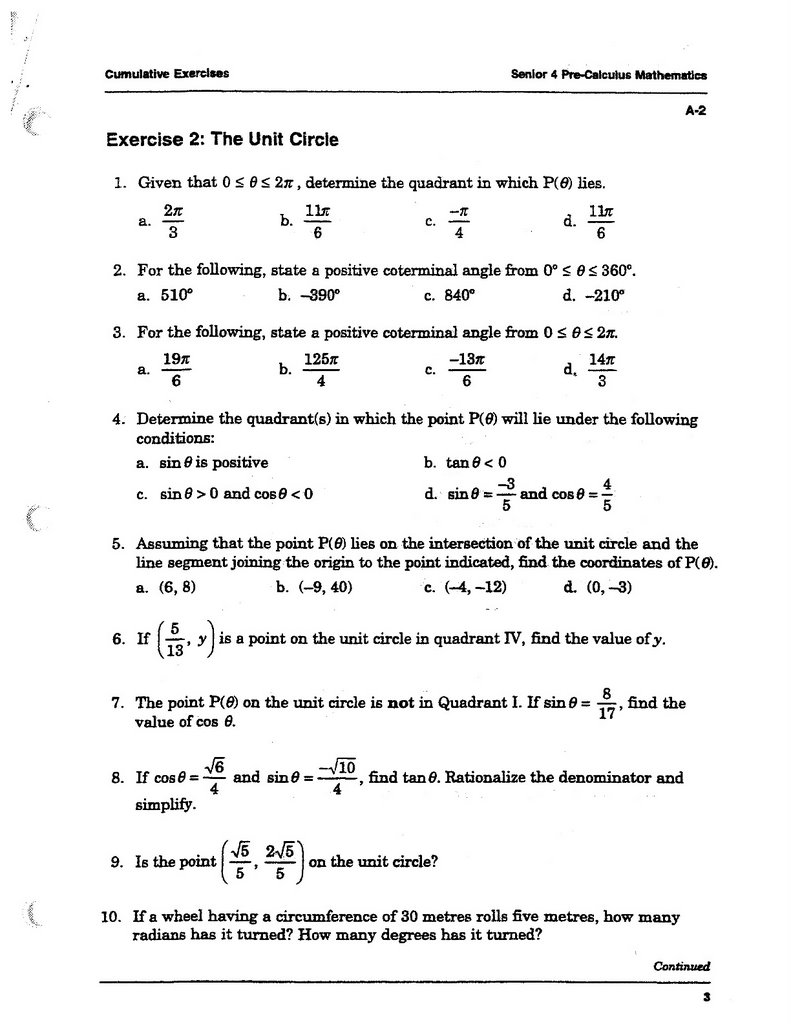
 10. All you have to do is set up a proportion ----> 5 meters over 30 meters = something (x) over 360 degrees and that will give you the number of degrees that the wheel turned. Then all you do is change it into radians and you are complete.
Next we went over question 5, 10, and 11 on exercise 2. (Click links to open questions)
Solutions:
5.
10. All you have to do is set up a proportion ----> 5 meters over 30 meters = something (x) over 360 degrees and that will give you the number of degrees that the wheel turned. Then all you do is change it into radians and you are complete.11. First you find the radius setting up a proportion between degrees and circumference. Then you set up another proportion between the degrees and the area that will then give you the final answer to the question.
After all of those questions that we had from our homework, we went onto memorizing the unit circle. We did this by Mr. Kuropatwa standing at the front of the class and being the unit circle. He would move his arm around and we had to call out the angle, sin of that angle, and cos of that angle. We also went into the tangents of each angle and how to figure those out. Once that was done we all had a quiz from 1 to 10 on the unit circle.
When we came back to class in the afternoon, all we did was questions on the board. The questions that we did will take you right into the homework which by the way is exercise 3 (1-20).
Don't forget to do your homework!
The next scribe is VINCENT.
Subscribe to:
Posts (Atom)